

The story of Villa La Bugia reaches back to one of Florence’s oldest noble dynasties, the Amidei family. In 1470, the property was acquired by Agnolo del Tovaglia, a prominent Florentine merchant whose circle included some of the most influential figures of the Renaissance. Among his notable guests was Francesco Gonzaga, the husband of Isabella d’Este and General Captain of Florence. In July 1500, Gonzaga wrote to Agnolo requesting a drawing and measurements of the villa. Just weeks later, on August 11, Francesco Malatesta, Gonzaga’s Florentine agent, dispatched a sketch of Villa Tovaglia to Mantua—remarkably noting that its author, Leonardo da Vinci himself, stood ready to produce a colored version or even a three-dimensional model.

Drawings of the relief of the Villa made by Leonardo Da Vinci
The estate’s narrative continued to unfold through the centuries. In 1803, it was purchased by the Morrocchi family, to whose descendants the property still belongs today. Under Costantino Morrocchi, sweeping renovations were undertaken in 1842, including the creation of a grand Italian garden and the addition of the elegant Lemon House—further enriching the villa’s architectural and cultural fabric.


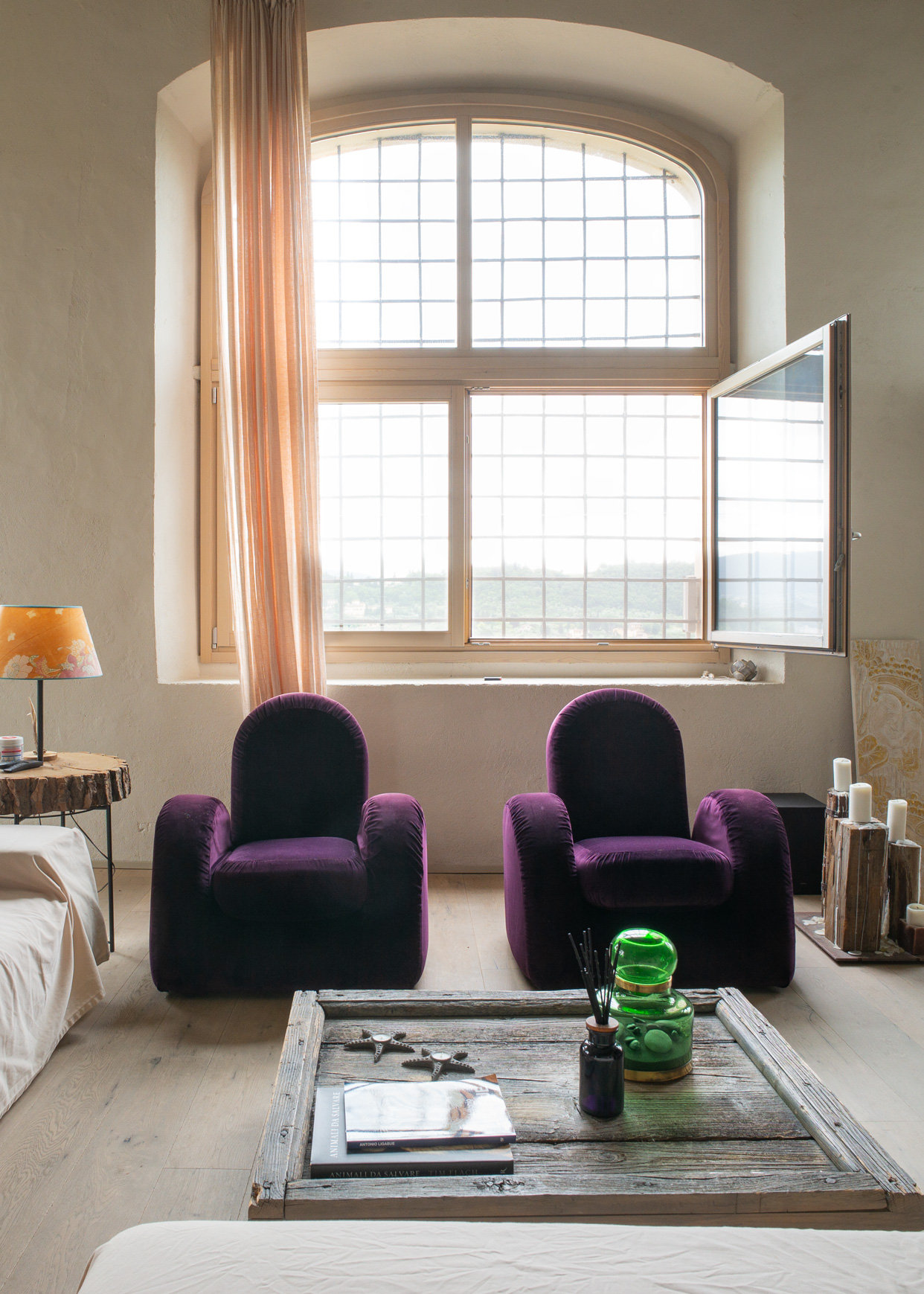
Now, after a meticulous restoration, Villa La Bugia’s historic annex has been reimagined for contemporary living. The new residence stands as an emblematic example of the regeneration of historical heritage—an architecture that inhabits time without nostalgia, maintaining a constant tension between memory and innovation, rootedness and lightness. The architectural project, both rigorous and poetic, succeeds in merging authenticity with contemporaneity: recovered plasters, original exposed wooden structures, and restored windows coexist in harmony with new elements of iron, glass, and natural lime.


The material palette is meticulously calibrated—natural oak floors, lime plasters with intentionally imperfect textures, and metal structures finished with subtle powder coatings. The interior design engages in a harmonious dialogue with the architectural shell, weaving together multiple languages: the minimalist sobriety of white and gray, the warmth of wood grains, and the discreet presence of contemporary art upon the walls.


This apartment is currently for sale. More details are available in our portfolio.